How to Choose the Best Fruit Dehydrator Machine?
Choosing the right Fruit Dehydrator Machine is more than comparing wattage and price. It affects texture, food safety, operating cost, and daily production consistency. FAO’s State of Food and Agriculture 2019 report estimates that about 14% of global food is lost between harvest and retail. Drying cannot solve every loss, but it can extend the useful life of ripe fruit.
Market research supports this growing interest. Grand View Research has identified increasing demand for food dehydration equipment, especially among households, small processors, and commercial kitchens. However, market forecasts differ by research company and product definition. The numbers are useful, but not perfect. Buyers should examine the machine, not only the headline growth rate.
A practical evaluation begins with airflow and temperature control. A sliced apple should dry evenly, without leathery edges and a wet center. Look for adjustable temperatures, stable airflow, removable trays, and food-contact materials designed for repeated use. The National Center for Home Food Preservation recommends careful preparation, consistent drying conditions, and proper storage after dehydration. These details matter more than a bright display.
Capacity should match your real workload. A family may need five trays, while a farm shop may require stainless-steel racks and continuous operation. Energy consumption also deserves attention. A cheaper unit can become expensive when it runs for twelve hours repeatedly. No machine is perfect. Noise, uneven loading, cleaning time, and calibration can still create problems. This guide compares those practical weaknesses with published guidance and industry evidence, helping you choose a Fruit Dehydrator Machine with greater confidence.
Set Drying Targets: Reduce Water Activity Below 0.60 for Shelf Stability
How to Choose the Best Fruit Dehydrator Machine?
A good fruit dehydrator should help you reach a measurable drying target, not simply produce crisp slices. Aim for water activity below 0.60 for shelf stability. The FDA’s Water Activity (aw) in Foods guidance explains that most bacteria, yeasts, and molds cannot grow at or below this level. The FDA Food Code 2022 uses 0.85 aw as an important safety threshold for certain foods, but fruit products need tighter control for longer storage. Do not rely on texture alone.
Choose a machine with adjustable temperature, steady airflow, removable trays, and enough space around each slice. A temperature range near 50–70°C suits many fruits, but thick mango pieces and thin apple rings will not dry equally. Measure the final product with a calibrated water activity meter. One reading is not enough. Test several pieces after cooling, because warm fruit can give misleading results. The National Center for Home Food Preservation also stresses uniform cutting and proper conditioning before storage.
Keep a written batch record. Note fruit variety, slice thickness, temperature, drying time, and aw readings. Aim lower than 0.60 when practical, especially for dense pieces. Still, lower aw does not repair poor sanitation or damaged packaging. I have seen attractive dried fruit soften inside sealed bags because moisture was unevenly distributed. That mistake is easy to repeat. Recheck the product after 24 hours, then inspect it during storage. Sources: FDA, Water Activity (aw) in Foods; FDA Food Code 2022; National Center for Home Food Preservation, Drying Fruits.
Choose Capacity: Compare 5–10-Tray Home Units with Commercial Batch Loads
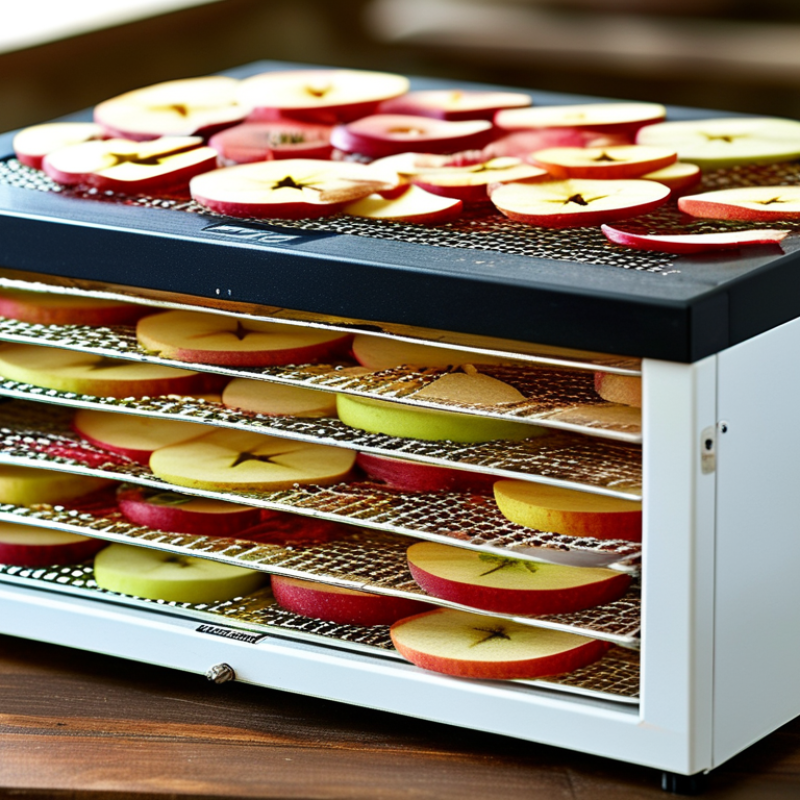
Capacity sounds simple. It is not. A five-tray dehydrator may suit occasional fruit snacks, while a ten-tray unit handles larger weekly batches. Measure usable tray space, not the advertised exterior size. Thin apple slices need room for airflow, especially when their edges nearly touch.
A home machine usually processes one to several kilograms per batch, depending on fruit density and moisture. Start with your real routine. Do you dry two mangoes after work, or several baskets of apples during harvest? Record the fresh weight and finished weight from one trial. My first estimate was optimistic because wet fruit occupied more space than expected. Smaller trays also require more loading and cleaning time.
Commercial equipment is different. Batch loads may reach tens of kilograms, but capacity alone should not decide the purchase. Check drying chamber dimensions, tray spacing, airflow direction, temperature stability, and recovery time after opening the door. A large load can dry unevenly if slices overlap or the chamber is packed too tightly. That mistake costs electricity and labor. It may also leave soft centers that need extra processing. Ask whether the machine supports your daily volume without constant supervision. A ten-tray home unit might be efficient for a small farm shop, yet frustrating for continuous production. Commercial capacity may be wasteful for a household. Leave expansion room, but do not pay for empty trays.
Evaluate Airflow and Heat: Prioritize Even Circulation at 35–75°C
How to Choose the Best Fruit Dehydrator Machine?
A good fruit dehydrator should control both airflow and heat with precision. For most fruits, a temperature range of 35–75°C offers practical flexibility. Lower heat protects delicate aroma and color. Higher heat can shorten drying time, but may harden the surface too quickly. Even circulation matters more than a powerful fan. Air should pass across every tray, not only the center. Check whether the fan sits behind the trays, where airflow usually spreads more evenly. Removable trays also make cleaning easier, which supports reliable food preparation.
Tips: Place similar fruit slices together. Keep each slice about 5–8 millimeters thick. Leave small gaps between pieces. Rotate trays halfway through drying if airflow seems uneven. A kitchen thermometer can reveal hot spots that the display misses.
I once dried apple slices with uneven thickness, and the thin pieces became brittle before the centers were ready. That mistake changed how I judge machines. Look for adjustable airflow, stable temperature control, and clear operating instructions. A glass door helps you inspect progress without releasing much heat. Stainless or food-safe interior surfaces are useful, but they do not replace regular cleaning. Test a small batch before filling every tray. Results can vary with fruit ripeness, humidity, and slice size. Even a well-designed machine needs attention. Temperature alone does not guarantee consistent texture.
Use these commonly published dehydration temperature ranges as practical setpoint guidance. For fruit, 57–63°C is a typical working range. When evaluating a machine, measure the air temperature at several tray positions after preheating; even circulation should keep readings close to the selected setting and prevent noticeably hotter or cooler zones.
Check Energy Performance: Compare kWh per Kilogram of Dried Fruit
When choosing a fruit dehydrator machine, energy performance deserves more attention than shiny features. Compare electricity use in kilowatt-hours per kilogram of dried fruit, not only rated wattage. A 2,000-watt unit may finish faster, yet consume more power per batch. Measure the result. Weigh fresh fruit before loading and dried fruit afterward. Record the meter reading, drying time, and room temperature. Then calculate kWh divided by the final dried weight.
Moisture content changes the calculation significantly. Apples, mangoes, and berries release water at different rates. Use the same slice thickness and loading weight during each test. Keep trays evenly spaced. Crowded trays restrict airflow and may increase kWh per kilogram. A practical test with small gaps between slices can improve consistency, although humidity and fruit maturity still affect results. Manufacturer figures are useful, but they often reflect controlled laboratory conditions. Treat them as references, not promises.
Look for adjustable temperature control, insulated walls, and efficient airflow. These features can reduce heat loss during long drying cycles. A reliable machine should also dry trays evenly, because under-dried pieces may require extra energy later. Check standby consumption too. It is easy to ignore. However, the lowest energy figure may not offer the best value. A slower machine can save electricity but consume more labor time. Test both options when possible, and keep your own records. My early comparison would have been unreliable because slice thickness changed between batches. That mistake still matters.
How to Choose the Best Fruit Dehydrator Machine? - Check Energy Performance: Compare kWh per Kilogram of Dried Fruit
Compare representative dehydrator configurations by useful energy consumption, output capacity, and operating conditions.
Energy Performance Comparison for Fruit Dehydrator Machines
| Dehydrator Configuration |
Typical Fresh Fruit Load |
Typical Dried Fruit Output |
Rated Electrical Input |
Batch Time |
Estimated Energy per Batch |
Energy per kg of Dried Fruit |
Typical Operating Temperature |
Best Fit |
| Small home dehydrator with stacked trays |
3 kg |
0.60 kg |
0.50 kW |
10 hours |
5.0 kWh |
8.3 kWh/kg |
50–70°C |
Occasional household use |
| Large home dehydrator with horizontal airflow |
6 kg |
1.20 kg |
1.00 kW |
10 hours |
10.0 kWh |
8.3 kWh/kg |
50–70°C |
Frequent household use and small batches |
| Small commercial cabinet dehydrator |
15 kg |
3.00 kg |
2.40 kW |
9 hours |
21.6 kWh |
7.2 kWh/kg |
50–75°C |
Farm shops and small food businesses |
| Medium commercial cabinet dehydrator |
40 kg |
8.00 kg |
5.00 kW |
9 hours |
45.0 kWh |
5.6 kWh/kg |
50–75°C |
Regular commercial production |
| Large insulated cabinet dehydrator |
100 kg |
20.00 kg |
10.00 kW |
8 hours |
80.0 kWh |
4.0 kWh/kg |
50–75°C |
High-volume processing |
| Heat-pump dehydrator with moisture recovery |
100 kg |
20.00 kg |
6.00 kW |
9 hours |
54.0 kWh |
2.7 kWh/kg |
35–70°C |
Energy-sensitive commercial production |
| Continuous-belt industrial dehydrator |
500 kg |
100.00 kg |
35.00 kW |
8 hours |
280.0 kWh |
2.8 kWh/kg |
50–80°C |
Continuous large-scale production |
Calculation basis: Energy per batch = rated electrical input × operating time. Energy per kilogram of dried fruit = energy per batch ÷ dried fruit output. The figures assume fruit loses approximately 80% of its mass during drying, consistent with many sliced fruits, and represent typical operating conditions rather than laboratory-certified ratings.
Verify Safety Controls: Use USDA-Aligned Temperature and Timer Settings
How to Choose the Best Fruit Dehydrator Machine?
Verify safety controls before comparing tray capacity or drying speed. A reliable dehydrator should offer adjustable temperature, a visible timer, and automatic shutoff. These controls reduce overheating when fruit slices finish overnight. USDA drying guidance places fruit dehydration near 135–145°F, depending on the fruit and preparation method. Choose a machine that can hold this range steadily, not one that only displays attractive preset buttons. A separate food thermometer is useful because built-in sensors can drift over time.
Cut apples into similar 1/8-inch slices, then test one tray before filling the machine. The center should feel leathery, not damp or sticky. USDA guidance also emphasizes conditioning dried fruit in a container for several days, shaking it daily to redistribute moisture. This practical step is easy to skip. It should not be skipped. USDA FoodKeeper data generally places dried fruit storage around six to twelve months in a cool, dry pantry, although moisture and packaging can shorten that period. Keep a drying log with temperature, start time, slice thickness, and texture observations. My own imperfect habit is checking texture too early; patience produces more reliable results. A timer helps, but it cannot replace a final visual and tactile inspection.