Leave Your Message
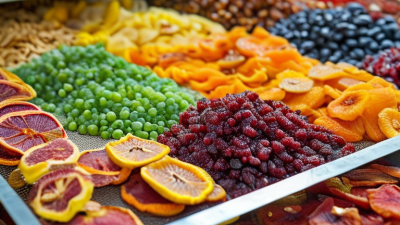
Food waste remains a serious global supply-chain challenge. The FAO’s State of Food and Agriculture 2019 report estimated that 14% of food is lost between harvest and retail. Fruits and vegetables are especially vulnerable because they contain high moisture and deteriorate quickly after picking. A properly selected Fruit Vegetable Dryer can reduce moisture, extend shelf life, and support more stable distribution. It can also help processors use irregular produce that might otherwise be rejected.
Yet drying is not simply a matter of applying heat. The right equipment depends on product thickness, sugar content, target moisture, energy costs, hygiene requirements, and production volume. Industry analyses from Grand View Research and MarketsandMarkets identify rising demand for food dehydration equipment, driven by processed foods, longer supply chains, and consumer interest in convenient ingredients. These reports are useful, but market forecasts should not replace site-level testing.
Small farms may prefer cabinet or solar-assisted dryers. Medium processors often need continuous belt systems. Large factories may require vacuum, freeze, or heat-pump technology for better quality control. Each option has trade-offs. Lower energy use may mean slower throughput. Faster drying may darken delicate mango slices or harden vegetable surfaces. This guide compares the top 10 types of Fruit Vegetable Dryer for global buyers, focusing on working principles, suitable products, capacity, energy performance, maintenance, and food-safety considerations. Real-world conditions matter. A machine that performs well in a brochure may disappoint in a humid coastal plant. Buyer decisions should combine manufacturer data, trial samples, and independent technical verification.
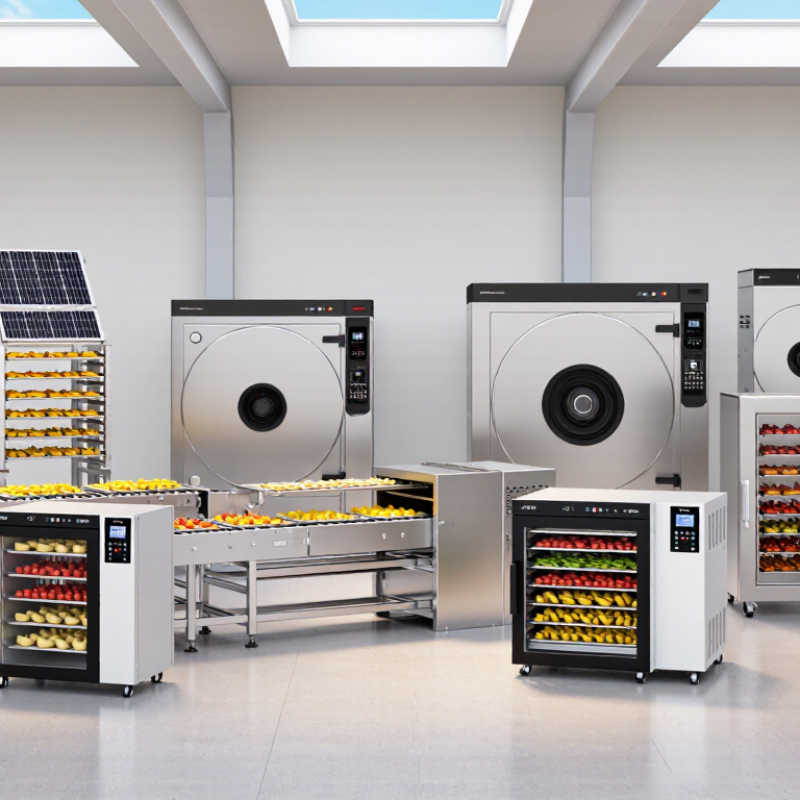
Fruit and vegetable dryers are machines that remove moisture from sliced, diced, or whole produce. They use controlled heat, airflow, and time. Less moisture slows microbial growth and helps extend storage life.
Common designs include cabinet, tray, tunnel, belt, vacuum, freeze, solar, and microwave-assisted dryers. Their working principle remains similar. Warm air passes across the product surface and carries moisture away. In vacuum systems, lower pressure helps water evaporate at a lower temperature. Freeze dryers remove ice through sublimation, protecting shape and color more effectively.
Preparation affects the result. Uniform slices dry more evenly than mixed-size pieces. Blanching can protect the color of vegetables, but it may soften their texture. Operators should load trays without overlapping pieces. Airflow needs clear paths. A practical check includes product temperature, drying time, final moisture, and water activity. Dry surfaces can still hide moisture inside.
Food-grade contact surfaces must be easy to clean. Sensors should be checked regularly, because a small temperature error can damage fruit quality. I have found that over-drying creates brittle edges and unnecessary weight loss. Under-drying is more concerning, even when the product feels crisp. Dryer selection depends on crop type, slice thickness, production volume, energy access, and the desired texture. There is no perfect machine for every harvest.
| No. | Dryer Type | How It Works | Typical Operating Conditions | Suitable Products and Feed Form | Indicative Capacity Range | Main Advantages | Key Limitations | Typical Energy Consideration |
|---|---|---|---|---|---|---|---|---|
| 1 | Open-Sun Dryer | Food is spread on trays or clean drying surfaces and dried directly by solar radiation and natural air movement. |
Ambient air Usually 25–40°C product-area conditions Drying time: about 1–5 days, weather dependent |
Whole or sliced fruit, leafy vegetables, herbs, and low-moisture crops. | Highly variable; commonly a few kilograms to several hundred kilograms per batch or drying area. | Very low equipment cost; no fuel or electrical heating required; simple operation. | Exposed to dust, insects, rain, contamination, and uneven drying; strongly dependent on climate. | Uses free solar energy, but requires large drying areas and may have high product loss in poor weather. |
| 2 | Solar Tunnel Dryer | A transparent tunnel traps solar heat while natural or fan-assisted airflow removes moisture from the product. |
Typically 40–70°C Drying time: approximately 1–3 days Airflow may be natural or forced |
Fruit slices, vegetables, herbs, mushrooms, and other sliced agricultural products. | Approximately 20–500 kg fresh product per batch, depending on tunnel size and climate. | Better hygiene and faster drying than open-sun drying; low operating cost; suitable for sunny regions. | Performance falls in cloudy or humid weather; temperature and airflow control are limited. | Primarily solar energy; small electrical demand when fans or controls are installed. |
| 3 | Hot-Air Cabinet or Tray Dryer | Heated air is circulated over products arranged on removable trays. Moisture evaporates from the surface and is carried away by exhaust air. |
50–80°C Drying time: approximately 4–24 hours Batch operation is common |
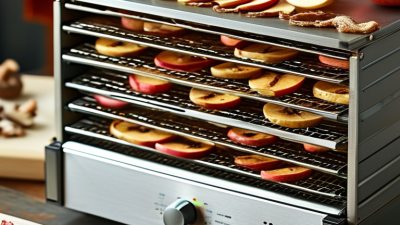
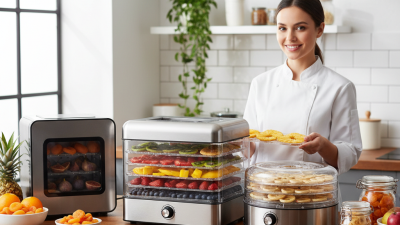
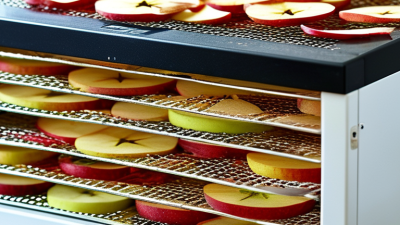
Apple, banana, mango, tomato, carrot, onion, herbs, mushrooms, and sliced vegetables. | Approximately 10–500 kg fresh product per batch for small and medium installations. | Simple design; relatively affordable; easy to clean; suitable for flexible small-batch production. | Manual loading and unloading may be labor intensive; uneven airflow can cause nonuniform moisture. | Usually electric, gas, steam, biomass, or heat-pump heated; energy efficiency is moderate. |
| 4 | Hot-Air Tunnel Dryer | Products travel through one or more heated zones on trays, carts, or conveyors while hot air flows across or through the product. |
50–80°C Drying time: about 2–20 hours Continuous or semi-continuous operation |
Fruit slices, vegetable pieces, herbs, mushrooms, and prepared food ingredients. | Approximately 100–2,000 kg fresh product per hour, depending on belt area, loading depth, and product moisture. | Higher throughput than cabinet dryers; configurable drying zones; suitable for medium-scale production. | Requires more floor space and controls; product may dry unevenly if air distribution is poor. | Commonly powered by gas, steam, electricity, biomass, or hot-water systems; heat recovery can reduce consumption. |
| 5 | Continuous Conveyor-Belt Dryer | A perforated or mesh belt carries the product through controlled hot-air zones. Air may flow upward, downward, or through multiple passes. |
50–90°C Residence time: approximately 30 minutes–8 hours Continuous airflow and feed control |
Diced vegetables, fruit pieces, berries, leafy vegetables, herbs, and products with consistent particle size. | Approximately 100–5,000 kg fresh product per hour, depending on belt width and moisture load. | Continuous production; good automation potential; controllable residence time and drying zones. | Higher purchase and maintenance cost; requires uniform feed size and stable product flow. | Thermal efficiency improves with air recirculation and heat recovery; energy demand depends heavily on final moisture content. |
| 6 | Fluidized-Bed Dryer | Upward-moving heated air suspends and agitates small particles, creating rapid heat and mass transfer between air and product. |
50–100°C Drying time: approximately 10 minutes–2 hours High-velocity airflow |
Small diced vegetables, peas, grains, chopped fruit pieces, granules, and blanched vegetable particles. | Approximately 50–2,000 kg fresh product per hour, depending on particle size and dryer design. | Fast drying; good air-product contact; relatively uniform treatment for free-flowing particles. | Not ideal for sticky, fragile, very large, or irregular pieces; airflow can cause breakage or carryover. | Generally higher fan power than static tray systems, but short drying times can improve overall productivity. |
| 7 | Vacuum Dryer | Reduced pressure lowers the boiling point of water, allowing moisture to evaporate at lower product temperatures. |
Product temperature commonly 40–70°C Typical absolute pressure: about 5–30 kPa Batch drying is common |
Heat-sensitive fruit pieces, vegetables, purees, extracts, and products where color or aroma retention is important. | Approximately 10–500 kg fresh product per batch, depending on chamber volume and product thickness. | Lower-temperature drying; reduced oxidation; better retention of color, aroma, and some heat-sensitive compounds. | Higher equipment cost; vacuum pumps require maintenance; drying can be slower for thick or poorly prepared products. | Electrical or steam heating plus vacuum-pump power; energy use is commonly higher than simple hot-air drying for small batches. |
| 8 | Freeze Dryer | Product is frozen, then ice is removed by sublimation under deep vacuum. A later desorption stage removes remaining bound moisture. |
Freezing often −40 to −10°C Chamber pressure commonly about 0.1–1 kPa Product temperature varies by formulation |
High-value fruit pieces, berries, vegetable powders, herbs, purees, and ingredients requiring porous, rehydratable structure. | Approximately 5–1,000 kg fresh product per batch, depending on shelf area and equipment scale. | Excellent quality retention; very low shrinkage; rapid rehydration; suitable for sensitive products. | Very high capital and operating cost; long cycle time; requires freezing and vacuum systems. | Usually the most energy-intensive option because it combines refrigeration, vacuum, and controlled shelf heating. |
| 9 | Spray Dryer | Liquid or slurry feed is atomized into fine droplets in a chamber. Hot air rapidly evaporates moisture and produces a dry powder. |
Inlet air commonly 120–200°C Outlet air commonly 60–90°C Residence time: generally a few seconds |
Fruit juice concentrates, vegetable purees, extracts, and liquid food ingredients; not whole fruit or large vegetable pieces. | Approximately 10–5,000 kg liquid feed per hour, depending on evaporation capacity. | Continuous operation; very fast drying; produces powders with controlled particle size and good flowability. | Requires a pumpable liquid feed; sticky or sugar-rich products may need formulation aids or specialized chamber design. | High thermal demand because large quantities of water are evaporated, although heat recovery can improve efficiency. |
| 10 | Microwave-Assisted Hot-Air Dryer | Microwave energy heats moisture inside the product while hot air removes vapor from the surface, reducing internal moisture resistance. |
Air temperature commonly 40–80°C Microwave power is product- and scale-dependent Drying time: often shorter than conventional hot-air drying |
Fruit slices, vegetable pieces, herbs, mushrooms, and products requiring faster drying with improved color retention. | Approximately 20–1,000 kg fresh product per hour, depending on microwave power and air-handling capacity. | Accelerated drying; potentially lower product temperature; can reduce case hardening and improve throughput. | Higher equipment complexity; risk of hot spots or uneven heating; requires careful control of load thickness and moisture. | Uses electricity for both microwave generation and air heating; efficiency depends on coupling, product geometry, and control strategy. |
Note: Capacity, temperature, pressure, and drying time are indicative engineering ranges rather than universal specifications. Actual performance depends on product variety, initial moisture, slice thickness, pretreatment, target final moisture, loading density, climate, and required quality.