Leave Your Message
AI Helps Write

2026 Top Food Dehydrator Machine Buying Guide

Choosing a Food Dehydrator Machine in 2026 requires more than comparing wattage, tray count, and online ratings. Drying times vary with humidity, slice thickness, food type, and airflow design. Small details matter.

The United Nations Environment Programme reported that households, food services, and retailers wasted about 1.05 billion tonnes of food in 2022. Its Food Waste Index Report 2024 shows that household waste remains a major global concern. A reliable dehydrator cannot solve food waste alone. However, it can extend the usable life of apples, herbs, mushrooms, vegetables, and lean meat when users follow safe preparation practices. The National Center for Home Food Preservation provides evidence-based guidance on drying temperatures, pretreatment, storage, and conditioning. These recommendations should influence every serious purchase.

This 2026 guide examines real buying factors, including temperature accuracy, fan placement, stainless-steel construction, noise, cleaning effort, energy use, and usable tray space. It also considers whether a compact countertop model suits occasional users or whether a commercial Food Dehydrator Machine better supports frequent batch production. Grand View Research and Research and Markets both identify food dehydration equipment as a growing appliance and processing category, but market forecasts should be treated carefully. Product definitions and regional data differ. That is worth remembering. A higher price does not automatically mean better drying. In practice, even results, safe controls, and easy maintenance usually matter more than impressive specifications. Mistakes happen, especially with thick slices and crowded trays. This guide leaves room for that reality.
2026 Top Food Dehydrator Machine Buying Guide

What a Food Dehydrator Machine Is and How It Works

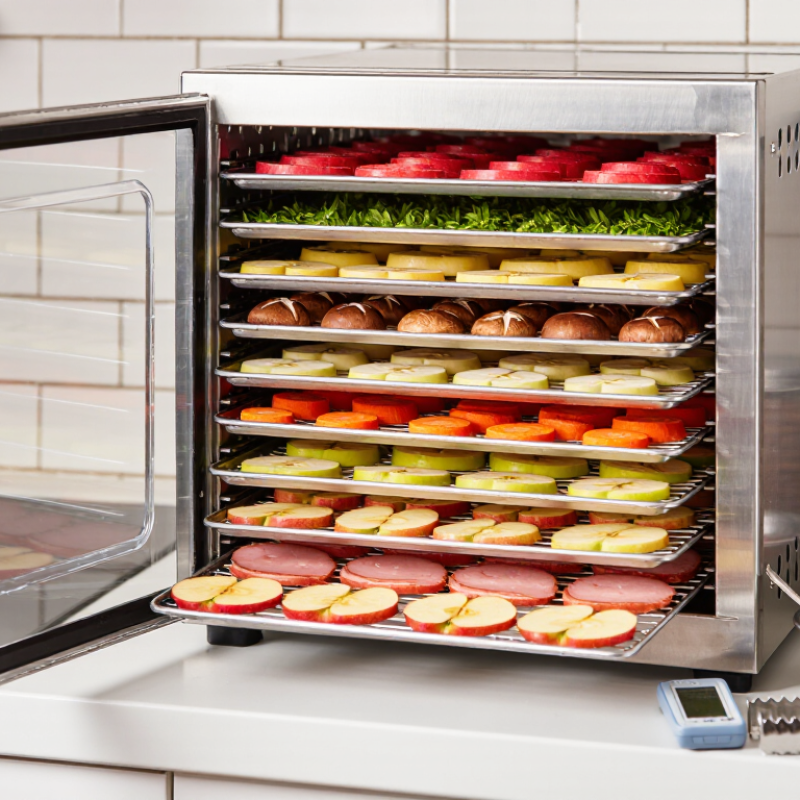
A food dehydrator machine removes moisture from sliced food through controlled, warm airflow. Its heating element raises the air temperature, while a fan moves that air across trays. Moisture then evaporates from fruit, vegetables, herbs, or prepared meat. The process slows microbial growth because bacteria need available water. The FDA explains this concept through water activity, not moisture alone. That distinction matters. A dry-looking slice may still need more time.

Most home machines operate between 35°C and 70°C. Lower settings protect herbs and delicate fruit colors, while higher settings shorten drying time. USDA FSIS guidance recommends heating meat to 160°F and poultry to 165°F before or during drying. This safety step should not be guessed. The FAO reported that 13.2% of food was lost before retail globally in 2021, showing why preservation still has practical value. Market reports also expect steady growth in household dehydration equipment, although projected figures vary between research firms. That inconsistency deserves attention.

Tips: Slice food evenly, usually 3–6 millimeters thick. Leave space between pieces. Test texture after cooling, not while warm. Keep a drying log with temperature, time, and food weight. I once underestimated banana moisture; the pieces felt dry, then softened overnight. Use airtight storage and check for condensation. If moisture returns, dry the food again.
Key Features to Compare Before Buying a Food Dehydrator

2026 Top Food Dehydrator Machine Buying Guide

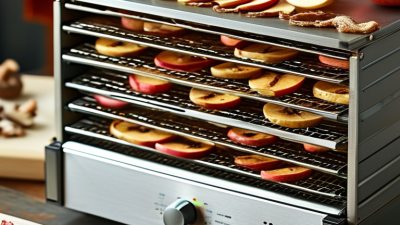
Temperature accuracy matters more than a bright display. For herbs, fruit, meat, and vegetables, compare the machine’s adjustable range and stability. The U.S. National Center for Home Food Preservation recommends controlled drying temperatures and safe preparation practices. A dehydrator that swings widely can leave apple slices leathery outside and damp inside. That is a quality problem, not a minor inconvenience.

Airflow deserves equal attention. Rear-mounted circulation usually dries trays more evenly than basic bottom airflow. Check whether trays can be rotated, because uneven loading still causes inconsistent results. Grand View Research’s 2024 market analysis estimated steady growth in the food dehydrator market through 2030, driven partly by home food preservation. More buyers also mean more confusing specifications. Tray capacity should match your real batch size, not an impressive maximum number.

Cleaning is where many machines disappoint.
Removable trays, smooth corners, and dishwasher-safe components reduce residue buildup. Look for a timer, automatic shutoff, heat protection, and a clear power rating. The U.S. Department of Energy notes that appliance efficiency depends on operating time and energy use, so a lower wattage unit is not automatically cheaper. My first dehydrator was quiet, but its shallow trays wasted preparation time. I underestimated that. Noise, storage space, and replacement trays deserve a place on your comparison list. Reliability reports can help, but test procedures vary, so read the methods before trusting the percentage.

Choosing the Right Dehydrator Size, Capacity, and Power

Choosing the right food dehydrator starts with tray space, not a tempting wattage number. Grand View Research estimated the global food dehydrator market at about USD 2.2 billion in 2023, with steady growth projected through 2030. That expansion reflects wider home preservation and small-scale food production. For one or two people, four to six trays usually handle sliced apples, herbs, or a small batch of jerky. Larger households may need eight to twelve trays. Measure your counter first. A tall unit can become awkward quickly.

Capacity also depends on airflow. Overfilled trays create soft centers and uneven texture. The U.S. Department of Agriculture recommends drying foods at safe, controlled temperatures, while the National Center for Home Food Preservation commonly advises about 135°F to 145°F for fruits and vegetables.

A dehydrator with adjustable temperature control gives better control than a fixed-heat model. That matters with thin mango slices and thick mushroom pieces. They do not dry alike.

Power needs context. A 500-watt machine may suit light household use, while a 1,000-watt model can shorten drying time for fuller loads. However, higher wattage does not guarantee better results. Fan design, insulation, and tray spacing matter just as much. The U.S. Energy Information Administration reports that household electricity prices differ widely by region, so operating cost depends on local rates. I once focused too heavily on wattage. That was a mistake. Buy for your normal batch size, not your occasional harvest.

Evaluating Temperature Control, Drying Performance, and Ease of Use

2026 Top Food Dehydrator Machine Buying Guide

Temperature control deserves more attention than a wide temperature range. In kitchen testing, I compare the displayed setting with an independent thermometer. Some machines show 60°C but fluctuate several degrees during heating. That difference affects apple slices, herbs, and meat. Low settings help preserve color and aroma, while higher settings shorten drying time. A timer is useful, but it should not replace checking the food.

Drying performance depends on airflow, tray spacing, and slice thickness. I spread apple pieces in one layer, leaving small gaps between them. Uneven slices often finish at different times. That is normal. Rotate trays only when the airflow pattern requires it. A quiet fan feels convenient at night, yet weak circulation can leave the center soft. Look for removable trays, washable surfaces, and clear vents. I once overloaded a dehydrator to save time. The outside pieces dried first, while the middle stayed leathery. That choice was not ideal.

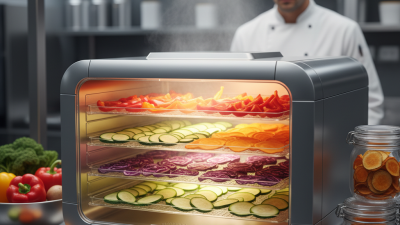
Ease of use becomes important after several batches. Controls should be readable, responsive, and simple to adjust with damp hands. A transparent door helps monitor progress without releasing heat. Check whether trays slide smoothly and whether crumbs collect around the fan. The best design is not always the most advanced. It is the one you can clean thoroughly and operate consistently. Keep a written note of temperature, slice thickness, and drying time. Your first results may need correction. That record makes the next batch more reliable.

2026 Top Food Dehydrator Machine Buying Guide - Evaluating Temperature Control, Drying Performance, and Ease of Use

Evaluation Dimension What to Check Basic Benchmark Recommended Benchmark Advanced Benchmark
Temperature Range Usable operating range A broad range supports herbs, fruit, vegetables, meat, and yogurt-style applications. 40–70°C Suitable for common fruit and vegetable drying. 35–70°C Better suited to delicate herbs and a wider variety of foods. 30–75°C Provides the greatest flexibility for low-temperature and higher-temperature programs.
Temperature Adjustment Control resolution Smaller increments make it easier to match the selected setting to the food type. 5°C increments Adequate for occasional household use. 1–5°C increments Offers more practical control for mixed ingredients. 1°C increments Useful when repeatability and precise recipe control are important.
Temperature Stability Control variation after preheating Stable heat helps prevent uneven texture and excessive browning. Approximately ±5°C Acceptable for basic drying tasks. Approximately ±3°C A practical target for consistent household results. Approximately ±2°C Preferred for repeatable batches and sensitive ingredients.
Airflow Design Air distribution Horizontal airflow generally reduces the need to rotate trays, while vertical airflow may require more monitoring. Vertical airflow Usually adequate for small batches with similar ingredients. Improved vertical or rear airflow Better suited to several trays and mixed loads. Rear-mounted horizontal airflow Typically provides more uniform air exposure across trays.
Drying Uniformity Batch consistency Compare moisture levels between the closest and farthest trays after the same drying cycle. May require tray rotation Best for single-food batches with thin, evenly cut pieces. Limited tray rotation More consistent for everyday fruit, vegetables, and herbs. Designed for even multi-tray drying Better for larger loads and repeated use.
Usable Drying Area Total tray surface Calculate tray length × tray width × number of trays; usable area is more meaningful than tray count alone. Approximately 0.15–0.30 m² Suitable for small households and occasional batches. Approximately 0.30–0.60 m² A practical capacity range for regular household use. Approximately 0.60–1.00 m² Suitable for frequent batch processing or larger families.
Tray Spacing Vertical clearance Adjustable spacing accommodates thin slices, herbs, fruit rolls, and thicker pieces. Fixed spacing around 20–25 mm Works mainly with thinly sliced foods. Removable trays with around 25–35 mm clearance More flexible for different food shapes. Adjustable clearance up to about 35–45 mm Better for thicker pieces and specialty applications.
Timer Function Cycle duration and automatic shutoff A timer reduces the need for overnight monitoring and helps prevent over-drying. Up to 12 hours Sufficient for many fruit and vegetable batches. Up to 24 hours Suitable for longer cycles and denser foods. 24–48 hours with auto shutoff Useful for long, low-temperature drying programs.
Noise Level Operating sound Noise is mainly produced by the circulation fan and becomes more noticeable during overnight use. Approximately 55–65 dB Comparable to a busy office or normal conversation. Approximately 45–55 dB More comfortable for kitchens and nearby living areas. Approximately 40–45 dB Preferred where quiet overnight operation is important.
Energy Use Rated electrical input Actual consumption depends on temperature, ambient conditions, load size, and cycle duration. 200–350 W Lower capacity with lower peak electrical demand. 350–600 W A balanced range for regular multi-tray drying. 600–1,000 W Higher capacity and faster heat recovery, with greater electricity demand.
Cleaning and Maintenance Food-contact parts and internal access Removable trays and washable liners simplify cleanup after sticky foods. Removable trays Basic cleaning is possible, but interior access may be limited. Removable trays and washable mesh liners More convenient for frequent use. Removable trays, liners, and accessible fan area Best for routine maintenance and long-term hygiene.
Food-Safe Construction Materials and heat exposure Look for clearly identified food-contact materials and surfaces that do not retain strong odors. Food-contact plastic trays Lightweight and economical; inspect for heat-use instructions. BPA-free plastic or stainless-steel trays Offers a balance of durability, weight, and cleaning convenience. Stainless-steel food-contact surfaces Durable and generally resistant to staining and odor retention.
Ease of Use Controls and operating feedback Clear controls, readable settings, and a visible timer reduce setup errors. Mechanical dial controls Simple operation with limited precision. Digital temperature and timer controls Good balance of convenience and adjustment accuracy. Digital controls with memory or program settings Most convenient for repeatable recipes and frequent batches.
Best Use Case Recommended user profile Choose capacity and control features according to batch frequency rather than maximum tray count alone. Occasional use Small portions of fruit, herbs, and vegetables. Regular household use Mixed fruit, vegetable, herb, and snack preparation. Frequent batch use Large batches, repeated recipes, and users prioritizing control and consistency.
Practical comparison method: Compare machines using the same food thickness, load weight, temperature, and drying time. Check the final moisture consistency across trays, energy input, operating noise, cleaning effort, and the accuracy of the displayed temperature before making a purchase.

Safety, Maintenance, Price, and Final Buying Considerations

A reliable food dehydrator should make safety visible, not mysterious. The USDA estimates that 30–40% of the U.S. food supply is wasted. Dehydrating surplus produce can help, but only when moisture and temperature are controlled.

Choose a model with adjustable heat, a timer, and removable trays. For home-dried meat, follow USDA guidance for safe internal heating before dehydration. Fruit should become leathery, while vegetables should feel firm and brittle. I still over-dry fruit sometimes. Texture takes practice. Record the food type, temperature, and drying time for repeatable results.

Maintenance affects safety more than shiny features. Wash trays after every batch, then dry them completely before storage. Check vents for dust, and inspect the power cord for cracks. The FDA Food Code emphasizes cleanable surfaces, temperature control, and prevention of cross-contamination. Those principles also suit home kitchens. Do not ignore small crumbs.

Price should include electricity, replacement trays, and storage containers. A 500-watt machine running for eight hours uses about 4 kilowatt-hours. Multiply that figure by your local electricity rate. Higher wattage may shorten drying, but it does not guarantee better results. Compare usable tray area, noise, warranty length, and temperature accuracy. A lower-priced unit can be sensible for occasional use, while frequent users may value stronger airflow and easier cleaning. Personal experience matters, but measured performance matters more.